
Which phobias are we born with?
 There are only two ‘innate’ phobias that we’re all born with, and any others are picked up along the way.
The only phobias we have at birth are the fear of falling and the fear of loud noises.
Every human is born with these two phobias. No matter where we’re born or what our culture , we’re all pre-programmed to be fearful of falling and to be scared of loud noises. Both are potential threats to our survival so it’s not too surprising that we have this in-built safety feature, is it?
Fear of falling
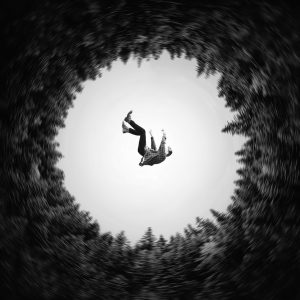
In 1960 there was a study called ‘The Visual Cliff’. It that showed that most babies who were encouraged to crawl across a see-through cliff towards their care giver refused to do it. This demonstrates our vitally important self-preservation instinct that stops us from plunging to our deaths, even at a very young age!
Loud noises!
We humans are all born with Acoustic Startle Reflex (ASR). It makes us react instinctively to loud noises, ready to react quickly to save ourselves from physical harm. This is when the parasympathetic response kicks in. We respond with our fight, flight, freeze or flop response in an attempt to escape the danger we perceive.
Nature v Nurture – the debate
There’s been an ongoing debate around the ‘Nature v Nurture’ topic for a very long time in the world of psychology. The dilemma is, how much of what we do, how we think and react is part of who we are naturally, (our nature) and how much is to do with way we are influenced by those around us and our environment (how we are nurtured).
The answer, in a nutshell, is that it’s a bit of both!
We’ve talked about the fears that we’re born with but what about the other stuff we may have phobias of? Where did they come from?
Where did that phobia come from?

There are a few ways that we can get a phobia. In my experience the most common way is when we’re startled in a way that our nervous system just can’t cope with. It’s what’s known technically as a Significant Emotional Event (SEE). So, if a dog jumps at us suddenly when we’re young we may become fearful of dogs and develop a phobia of them.
Other times we may develop a deep-seated fear of something when we see a care-giver responding in an extreme or fearful way to something, especially if we’re very young at the time.
Maybe your mum always panicked whenever there were wasps around, flapping her arms, screaming and running away and now you do exactly the same thing?
Our unconscious thought process goes something like this; “If they’re scared then surely, I should be scared too!” In other words, we learn by example that it’s something scary and we react accordingly.
More rarely, we might become phobic about something if we are presented with enough negative and possibly inaccurate information about that thing.
Here’s a couple of examples to show you what I mean (you can find more in the reviews section of my website).
Frogs v Me (a significant emotional event)!
When I was a little girl, I opened the front door one evening to put the empty milk bottle on the doorstep ready for the milkman to swap for a full one the next morning (yes, I’m that old!).
As I opened the door a massive frog leaped at me menacingly and made me jump out of my skin! At least that’s how it felt to me at the time. I’m sure the frog was just as terrified as I was, if not more so.
It was only years later that I realised the lasting and dramatic impact that one frog had had on my neurology. I came across a frog on the loose and I had a complete melt down. I’d always had some awareness that I didn’t like frogs but they’re not creatures you see every day are in the UK they?
It wasn’t something that was a daily hassle for me but, every time I saw a frog, no matter its size, I would have the same reaction of terror. If I saw a pond or had the inkling that there might be a frog on the loose, I would do my best to avoid the situation to protect myself from having a fright. Sound familiar?
Fast forward quite a few years and I was training to become a Hypnotherapist. It was time to learn how to help my future clients to fix their phobias. I got to practice with my fellow trainee. In just one session he helped me to fix my frog phobia and I helped him to fix his phobia of heights. That’s what you call a win-win!
How I knew it was gone
A few months later I went on holiday to Thailand, and it was the first chance I had to test that I no longer had a frog phobia. There were frogs everywhere! The good news is, I loved them. Instead of avoiding anywhere I thought they could be, I found myself searching them out and crouching down to look at them! I was so relieved that I was no longer afraid of them and my holiday wasn’t ruined. I could relax and enjoy everything completely. This is a photo of one that i made friends with whist sat on the loo!
Ever since I’ve loved helping my clients to fix their phobias too. Especially the phobias that have become life limiting.
Spiders v Sam (thanks to her dad!)
One client, let’s call her Sam, came to get my help to rid herself of Arachnophobia. She told me that she could remember her dad always screaming, jumping onto the sofa and shouting for the whole family to do the same whenever a spider appeared in their living room.
Now I know it might be a stereotype but, most of us probably see our dads as strong and tough and fearless, our protector. So just imagine your, generally, strong tough fearless dad who protects us from harm and danger, suddenly starts yelling and jumping onto the sofa and shouts for the whole family to follow suit.
How would that feel to a small child who puts their complete trust in this human being to look after them and keep them safe? I reckon they’d be pretty terrified! You’d soon learn that those little black 8-legged creatures are absolutely terrifying and are to be avoided at all costs, wouldn’t you? Your unconscious response might be, “If dad is scared, it’s something really scary and I’d better make sure I copy him to stay safe!”
How to fix a phobia
If you’re like me you probably know logically that being scared of frogs, spiders, needles or whatever, might be bit of an overreaction. But that doesn’t help us to not be scared, does it?
Why? Well, it’s because that reaction is an unconscious one. It’s locked into the part of our mind that stores all our memories and automatic pilot, our unconscious mind. No amount of logic or reasoning can undo or re-programme it. We have to tackle it on an unconscious level and that’s where my toolkit comes in!
How long does it does to fix a phobia?
Generally, just one or sometimes two sessions are enough to be rid of a phobia. It’s incredible isn’t it that something scary we’ve lived with for a long time can be gone in under 2 hours? Its power over us broken in such a short time!
It’s a really quick, fun and painless process and that’s why I love it so much.
What’s not to love when I can help my clients go from not being terrified to get on an aeroplane and go on that longed for holiday to happily looking forward to it, enjoying the flight and relaxing on holiday without a thought for the return journey?
One lady was able to stop panicking about a monthly injection that’s she needs as part of her vital medical treatment to being able to inject herself calmly and without fuss.
Others I’ve helped have gone from not being able to leave a room if they spot a spider to being able to calmy pick it up in a glass or tissue and put it outside or go in their garage for the first time.
Then there was the young lady I helped who was able to get back behind the wheel and drive after a serious car accident. She hadn’t driven for 18 months and had stopped going out, except to work, making excuses to friends to avoid being a passenger in a car that wasn’t being driven by her partner.
The list goes on. So…..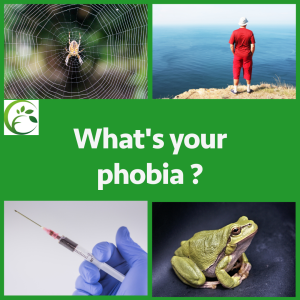
What’s your phobia? How could it change your life if it wasn’t there anymore? Where is your phobia stopping you going and what’s it stopping you enjoying? Why did it start? When will you get it fixed?
How about now? Just get in touch or book your session here and I’ll see you in my therapy room soon.